
If you’ve been reading Animacy for a little while, you know that I’ve been reflecting a lot on the structural changes that the AI era is bringing to most (if not all) industries. If you haven’t yet, I suggest you start by reading my first and third posts, then come back here. They’ll help you understand what kind of people organizations should find to succeed in this transition.
What’s an organization?
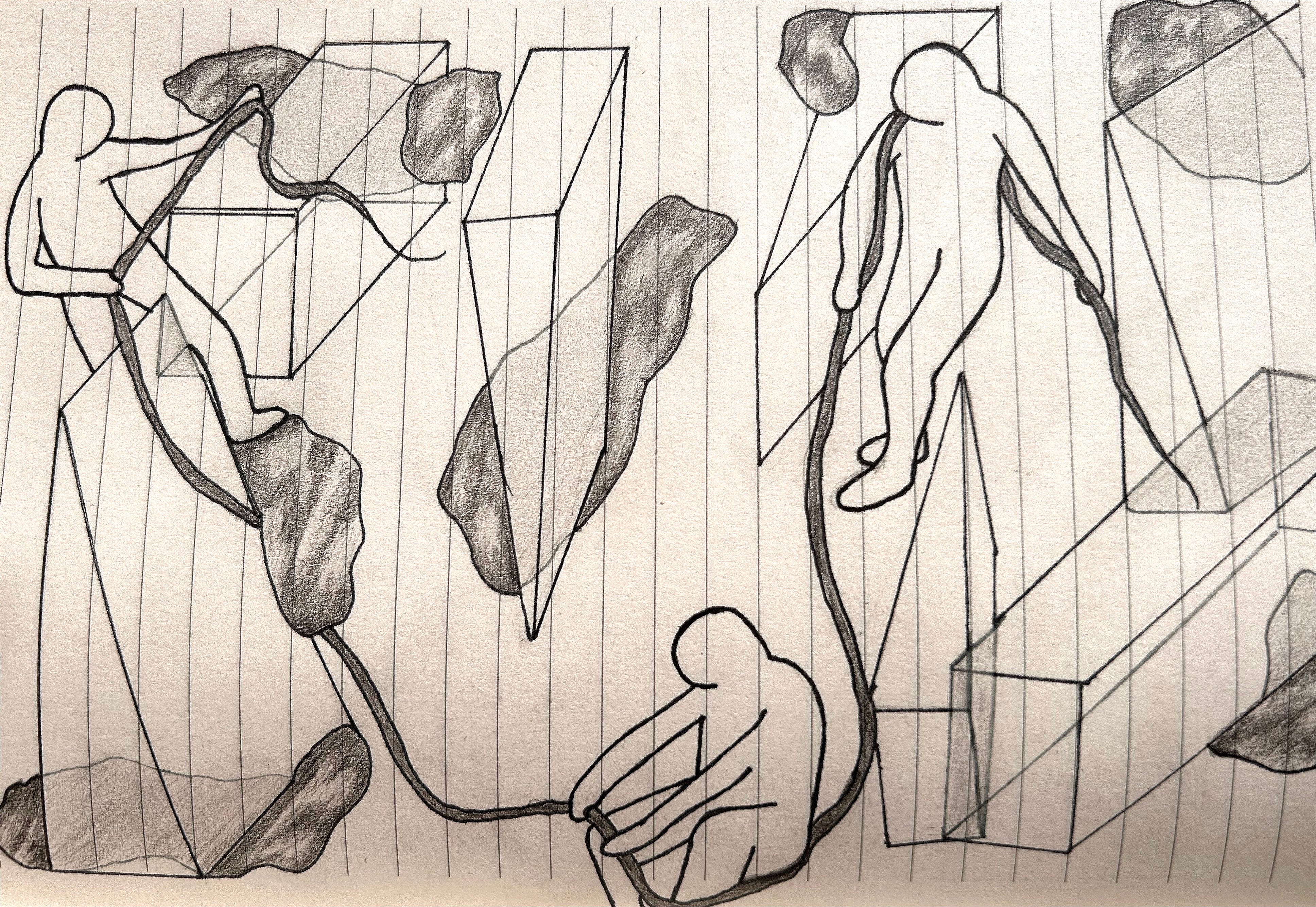
What is an organization? For most of us, they’re a given. They’re part of a modern society and central to how we interact and navigate the world. We’ve grown up with our parents, family, or friends working in one. We’ve experienced them as consumers of products, goods, and entertainment. And for some of us, we’ve even worked at one (or many).
But what is an organization really? That question is complex because organizations are complex. They are the product of a web of interactions between people, systems, and missions. They have layers of coordination and hierarchies mixed with rewards and incentives, so that what gets produced is useful, profitable, and in some cases, innovative.
Since the mid 20th century, the field of organizational design has been tasked with optimizing org ‘blueprints’ so that all the parts work together, coherently, to reach a specific goal. In a nutshell, how do you get a group of people with different knowledge, interests, and capabilities to produce something together that none of them could alone?
That question is as relevant now as it ever was. Maybe even more so. And AI is changing the conditions under which we try to answer it, because it’s accelerating individual output, and making some coordination mechanisms redundant overnight.
Back to the future
There’s a lot of noise right now about what AI means for how we organize and work, so I’m going to do what I always do when things get complicated: deconstruct concepts back to their core parts. And focus on a few components at a time (don’t try to boil the ocean, as they say).
In this essay, I’ll be looking back at how organizations evolved across various eras to better understand two core components:
How knowledge moved between people
How effort was coordinated
From there, I'll put my designer hat on and start to sketch what a better blueprint might actually look like for the era we're transitioning into.1
Era 1: the guild
~Before 1850
Before industrialization, the dominant organizational form was the guild. A community of master craftspeople, journeymen, and apprentices organized around a trade. The coordination mechanism was proximity and transmitted knowledge: you learned by being close to someone who already knew the craft.
Example: A medieval goldsmith's apprenticeship lasted seven years, working beside someone who already knew the craft on real commissions. Mistakes were visible immediately and had to be corrected in the next piece. The craft transferred through proximity and consequence, not documentation. The workshop was the coordination mechanism. There were no managers.
What it rewarded: craft mastery, years of apprenticeship, reputation within a trade community.
Who thrived: deep craft specialists with long time horizons and strong guild membership.
What broke it: the industrial revolution changed the unit of analysis from the individual craftsperson to the coordinated system. Leverage was now scale rather than depth of craft.
Era 2: the machine
~1850–1940
The dominant form was the factory and the bureaucracy. Work was decomposed into its smallest possible tasks, each measured and optimized independently. The coordination mechanism was hierarchy and standardization: managers planned, workers executed, and rules governed every point of contact between them. The machine did the coordinating. The worker did one thing.
Example: Ford’s moving assembly line at Highland Park brought a Model T from 12.5 hours to 93 minutes. Taylor’s experiments at Bethlehem Steel nearly quadrupled pig iron output by prescribing the one best method for every motion.2
What it rewarded: efficiency, output per unit of time, procedural compliance.
Who thrived: the reliable executor who could master a decomposed task, the procedurally correct administrator.
What broke it: knowledge work. You couldn’t decompose thinking and judgement into subtasks.
Era 3: human relations
~1930–1960
What was being built had become too complex for pure task decomposition. Aircraft, telephone exchanges, consumer appliances. These required engineers talking to designers talking to production workers. Judgment was needed at every interface, and so were workers who understood enough of the whole to make good local decisions. The coordination mechanism became management attention and group norms: get the best from people by treating the worker as a social being whose judgment is part of the system.
Example: HP was built on the theory that engineers' best work came from understanding what they were building and why, not from following prescribed methods. Hewlett and Packard walked the factory floor daily, talking directly to engineers about their work to understand and unblock. Decisions about how to solve a problem were pushed to whoever was closest to it.
What it rewarded: morale, cohesion, loyalty, the ability to inspire people.
Who thrived: the good manager who could read the room, the team player who contributed judgment not just compliance.
What broke it: the absence of a structural theory. Knowing workers have intrinsic motivation doesn’t tell you how to design the system around them. The human relations school was excellent at describing the person and largely silent on the organization itself.
Era 4: the adhocracy
~1960–1980
The Cold War and the pace of technological change meant organizations were being asked to build things nobody had built before, against problems that couldn’t be anticipated. On top of that, the professional expert class had arrived at scale. Organizations were full of people whose expertise exceeded their managers’ comprehension. The coordination mechanism was meant to adapt to this changing context quickly: match the org structure to what the environment demanded at the time, and let authority follow expertise rather than title.
Example: Bell Labs ran an organic structure. No one prescribed the collaboration. The structure assumed people would find each other when necessary. The result: the transistor, UNIX, and nine Nobel Prizes. NASA's Apollo program needed a way to coordinate interdependent problems across 400,000 people. The answer was a matrix. Engineers reported both to a functional department head, who maintained technical standards across the organization, and to a project manager, who was accountable for a specific mission component.
What it rewarded: matching structure to context, expertise-based authority, lateral coordination.
Who thrived: rapid innovators and people that work best in non-formal, problem-based environments.
What broke it: the leading organizational frame moving from “what structure fits your context” to “what strategy are you pursuing and how do you measure performance against it.” Objectives and competitive positioning became the primary lever.
Era 5: the performance model
~1980+
The shift was driven by converging pressures. Capital markets gained power over management decisions. Institutional investors, hostile takeovers, and shareholder primacy meant organizations now answered to quarterly returns in ways they hadn’t before. Strategy replaced structure as the primary management lever. Work was governed by objectives, reviewed against outcomes, and rewarded through credentials and rank.
Example: GE’s vitality curve under Welch divided every employee into top 20%, mid 70%, and bottom 10%. The bottom was fired annually, and the market cap moved from $12 to $410 billion.
What it rewards: measurable output, credentials, rank relative to peers, visible achievement.
Who thrives: the credentialed achiever, the ambitious strategist, the person whose contribution fits cleanly into a performance review.
What breaks: the management layer that coordinates the model can also be the bottleneck. As digital tools routed information faster than human managers can, the layer that translated between strategy and execution became expensive and slow.
Era 6: the startup model
~2010+
Software demonstrated that small autonomous teams could build products of extraordinary value. This winner-take-all economics meant speed to market mattered more than coordinated efficiency. The dominant form was the attempt to remove hierarchy and replace it with culture, shared purpose, and self-management.
Example: At Buurtzorg, 14,700 nurses were organized in self-managing teams of twelve. It had 8% overhead costs versus a 25% industry average because each team was small, bounded to one neighborhood, with a purpose specific enough that mutual adjustment could handle all coordination.
What it rewards: autonomy, self-direction, the ability to manage yourself without oversight.
Who thrives: the highly autonomous, psychologically robust generalist.
What breaks: scale and the friction of doing coordination work without coordination mechanisms. Removing hierarchy without replacing what it coordinated.
The new blueprint: knowledge transfer and coordination
The only mechanism that reliably transfers tacit knowledge is exposure to other people’s reasoning, and tight feedback loops. Knowledge integrates from retrieval in context, by encountering the right piece of reasoning at the moment it needs to be applied. I think the guild did this best, through prolonged exposure to the master.
But with the flow of information picking up exponential speed, the gap between what an expert does and what they can articulate is becoming increasingly difficult to close. That’s why other eras didn’t succeed in integrating the guild effect, and also why now is the best time to solve the problem of weaving it back in.
At the same time, the mechanism that enables coordination is shared visibility of work in progress, to the people who need to see it and make decisions about it. In the guild, you could see what the person next to you was making and where they were stuck. In the adhocracy, experts found each other because the problem required it, and the organic structure made those collisions possible. And the startup model had bounded scope: problem boundaries defined the limit of necessary coordination.
But AI is dismantling this. Every person’s AI context is siloed. One person with good AI tools can now produce what a small team used to. But those outputs don’t automatically cohere into something collective. They accumulate in separate contexts, produced by people who may be working on adjacent problems without knowing the other exists.
How do we solve these design challenges?
What’s interesting now is that when someone works through a real problem with AI, every step leaves a trail. That wasn’t true for post-guild eras. The first prompt reveals how they framed the problem. The edits to the output or the decision to stop and try something different show what the person thought was missing.
I think the new organizational blueprint needs to leverage this, and build AI knowledge transfer and coordination into the main infrastructure. It needs to be centralized and do three things.
First, every AI reasoning session produces a structured artifact automatically. This might look like a decision log based on what was tried, what was rejected and why, and where judgment was exercised at each fork. It should be automatically tagged by problem type, stored in a shared substrate, and require zero extra effort from the person who did the work.
Second, when anyone on the team (or adjacent teams working on similar problem types) faces a similar decision, the infrastructure should automatically deliver relevant reasoning when it needs to be applied. People shouldn’t have to go digging for it, and it shouldn’t be bound to current hierarchical structures. This person faced this exact fork three months ago. Here is how they reasoned through it and how it applies to your problem.
Third, reasoning is available in whatever format makes most sense to the task and to the person receiving the information. I’m thinking voice narration, visual decision maps or graphs, or annotated judgment calls. Text isn’t always the best, and I think people are becoming increasingly overloaded because they are reading too much information-dense text. Input formatted to match the context will increase the chances that knowledge is actually transferred and integrated successfully.
What the new blueprint needs to reward
Right now the AI transition rewards individual output, AI fluency, and speed of execution. The person who generates the most, fastest. That’s the current default.
But I think the org blueprint that gets this right will reward the quality of reasoning embedded in output, not the volume of output itself. Because the artifact stream makes reasoning visible and traceable, you can see for the first time whose thinking actually changed what others were building. Output that generates no downstream consequence looks different from output whose reasoning propagates through five subsequent decisions across adjacent teams.
Organizations that implement these structural changes will be best positioned to transfer relevant knowledge and coordinate information across all problem spaces, no matter where they sit in the org. And they will be able to see and reward the people who contribute most to this new structure.
From there, the next design decisions should follow naturally: which structural components are now redundant? What is the right team structure once knowledge transfer and coordination are solved? How is mission-aligned work determined? How is performance assessed? I’ll be exploring those questions soon, so make sure to check back in.
You’ll notice that our modern organizations have kept some pieces from the past, or are still operating according to a past era’s blueprints. Current org shapes depend on many factors like resistance to change, context, and operating model. What I’ll be showing you is the prevalent mode for each specific era.
When organizations talk about automating tasks with AI today, they are largely using this same frame: decompose the work to its smallest unit, automate each unit, sum the result. This works for tasks whose value is their output. It breaks for tasks whose value is the thinking embedded in producing them. When you automate the task without preserving that thinking, you produce the output without the value.