
For a long time, I thought simple equaled laziness. A simple solution or answer signaled that the person didn’t care to go deeper. They didn’t take the time to ask why. To sit with the problem long enough for it to grow and connect to other problems, concepts, or phenomena. To see that a lot of things in our world are products of intricate and interconnected systems.
I took pride in my ability to test the edges of complexity. And I never missed an opportunity to show that I had done my homework, and spent precious minutes in meetings explaining how I got to a recommendation, thinking this would earn more trust with my stakeholders. “She knows what she’s talking about”.
But leading with complexity constantly backfired. People got lost along the way. They didn’t trust me more, because they didn’t understand what I was trying to solve or why they should care. With some trial and error (ok, a lot of trial and error), my relationship to simplicity evolved. In this essay, I want to share with you what I learned in my journey: both complexity and simplicity play a role in the process of discovery. Understand the intricacies first, then solve and communicate with simplicity. Let’s dive in.
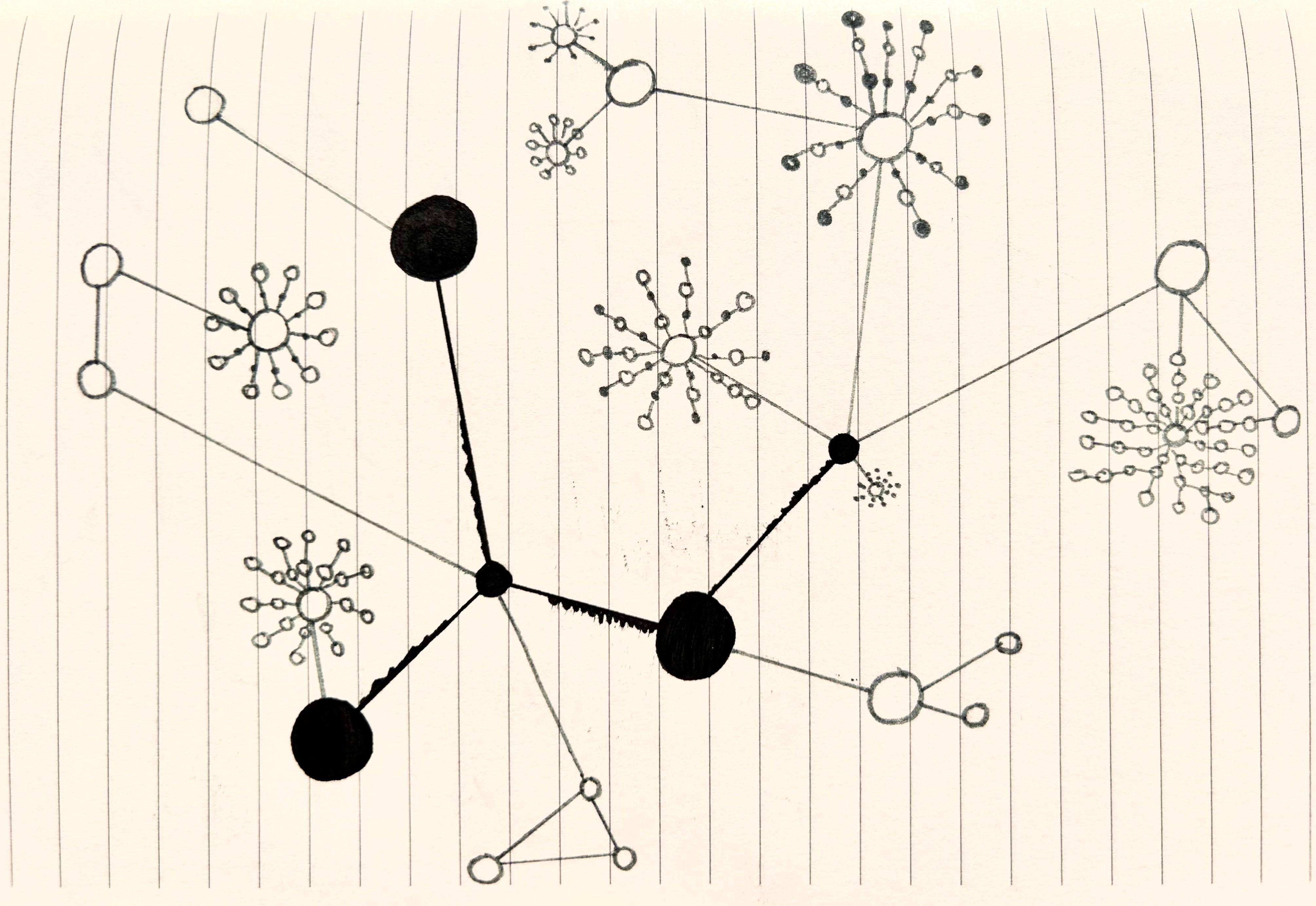
What is complexity
A complex system1 is the product of hundreds (or thousands or millions or trillions) of interactions among simple, interconnected components. You can spot a complex system by looking for these five things:
Layered structure. Simple parts combine into stable units that become the parts of something larger. Bases build genes, genes build cells, cells build tissue. Complexity stacks in levels rather than sprawling flat.
Emergence. The system produces behavior no single part contains. No neuron holds a thought; the thought appears only in the firing between millions of them.
Interdependence. The parts respond to each other, so you can’t understand one in isolation. A single price in a market means nothing until you see what every other buyer and seller is doing in relation to it.
Nonlinearity. Effects aren’t proportional to causes. One severed power line can black out a whole grid, while adding a dozen new lines might change nothing.
Self-organization. Order arrives from the bottom up, in a spontaneous manner. A trend goes viral because people are sharing, and a coordinated wave forms out of local copying.
Because the rules governing individual components are simple and few, complex systems are actually generated by far less than we might initially think. The clearest case is genetic code. Every living thing is built from sequences of just four bases, and each base follows an almost trivial rule about which other base it pairs with. The entire diversity of life comes down to how many simple-ruled parts interact, not to any part being intricate in and of itself.
Why complexity exists
But why do all these self-contained, simple components generate so much complexity when they interact? Why is it needed? Wouldn’t the world be better if things were simpler?
When the environment is stable and predictable, a fixed, simple system is enough. It can meet every situation with the same small set of responses, because the situations barely change. But when the environment is varied and keeps shifting (which is arguably, the world we live in), a fixed system gets overrun.
Complexity is survival. It allows the system to carry enough range to meet a world that keeps producing situations it hasn't seen before. Which means simplifying can never be about deleting complexity entirely. We need it, to some extent.
So what is simplifying, and why is it useful?
Why simplifying is powerful
Remember that complexity emerges from simple local rules. Genetics, ant colonies, markets. The greatest thinkers are people who are able to reverse engineer complexity back to its simple parts. They look at complex, tangled situations and ask: what is the small set of simple rules or mechanisms actually generating all this? They find the core.
That’s powerful, because the ability to simplify a complex system is what lets you act decisively, get others to follow, and spend your effort where it actually matters, without getting stuck in the mess. It breaks down into four advantages:
Simplicity as leverage
Complex systems are nonlinear, and in a nonlinear system, you can’t enumerate and control all the interactions, because there are too many. And they cascade. The move is to find leverage points: the few places that are meaningful to describing the whole system. That’s elegant, and the difference between spending effort proportional to the mess, versus spending it proportional to the cause.
Simplicity as building blocks
Recombining simple, stable parts is a central mechanism of how complex systems get built in the first place. A clean, simple solution can enter that same process: it becomes a building block others build on, and it compounds across the whole system, while a complex, special-cased solution is a dead end.
Simplicity as a smaller surface of failure
Every bit of unnecessary complexity is surface area for emergent failure. Ten interacting components have 45 possible pairwise interactions, twenty have 190. Each added part interacts with all the others in ways you didn’t design and can’t predict. Simplifying shrinks the interaction space, which shrinks the space for emergent bugs, side effects, and unintended consequences.
Simplicity as mental modeling
A person who simplifies well is building a good mental model of the system. The naive simple answer (without understanding) is just ignorance. The elegant simple answer (after understanding) is mastery. They can look similar, which is why elegant simple solutions often seem obvious in retrospect. But whoever holds the best model can predict, act, and explain it, while others can get paralyzed by the full mess.
A quick take away
Complexity isn’t going away. If anything, the world is becoming more unpredictable, more information is coming at us, and our ability to reason about it is shrinking. Because everything moves so fast, processing complexity and simplifying is one of the greatest superpowers you can build. Here’s a quick recipe:
Find the core. Ask what one subset of rules, if you understood only that, would let you work out what the system is about. Finding it tells you what’s worth your time, money, and attention, and what is just noise you can safely ignore. It lets you put more effort on the parts that carry the system, versus evenly across the mess.
Cut without ego. Understand the complexity first. If you skip that part, your simplification will be naive. Once you understand enough though, and are ready to explain it to others, cut everything that’s there to show your work rather than move the goal forward, like the extra context that proves how much you know, or the caveat that shows you thought of everything. If it doesn’t serve the core, it goes. This makes it a lot cleaner for other people and gets to the point of why they should care.
Test by reversal. A good simplification survives someone asking “wait, why?”. You can go one layer deeper on demand, because you took time to understand the details before simplifying. This is how you know your simple version is real and not a guess. The reversal test is your own check that you actually understand the system.
Don’t oversimplify. Cut the complexity that’s noisy, but keep the meaningful complexity the core of problem itself contains. Simplifying doesn’t mean simple for simplicity’s sake. If you remove meaningful complexity, you won’t get a simpler answer, you’ll get a wrong one that sounds clean and confident, and you’ll act on it and invest in it, only find out it was hollow when it breaks. As Einstein put it, as simple as possible, but no simpler.
Start with one thing this week. Maybe the most tangled problem on your plate. Don't explain it better. Find what's generating it, and cut everything else. See what happens.
This essay is about systemic complexity. Plenty of things get called complex that aren’t, like a tax form, a dense legal contract, or a sprawling technical manual. Those are complicated. They contain lots of detail, but you can understand them piece by piece, and no amount of studying one clause changes another.
Great read, Eve! Simplifying the complex is something I’m actively learning and practicing as well!
This post is truly fascinating. I would add a darker side of this dynamic, however. Simplicity is also a highly dangerous tool. While it clarifies systems, demagogues weaponize reductionism to bypass critical thinking and manipulate public consensus. True synthesis distills depth, but authoritarian propaganda exploits simplicity solely to erase nuance and enforce total control.